There is a particular kind of silence that fills a kitchen just before you start baking. The bowls are out. The oven is warming. You stand there, looking at a handful of simple things flour, sugar, butter, eggs and wonder how something so ordinary could turn into something so comforting. That question, quiet and curious, is where every baker begins.
At our Baking Institute In Chennai, we have seen that question on the faces of hundreds of students. Some arrive nervous. Some arrive overconfident. Most arrive somewhere in the middle, eager to learn, but unsure of where to actually start. And almost always, the honest answer to their first big question starts in the same place.
It starts with understanding ingredients. Not memorising them. Understanding them. Because baking is not about following a recipe blindly. It is about knowing why each ingredient is there, what it does, and what happens when one of them is missing or wrong. That understanding shapes everything that comes after.
Basic Ingredients Needed for Baking Cakes and Cookies
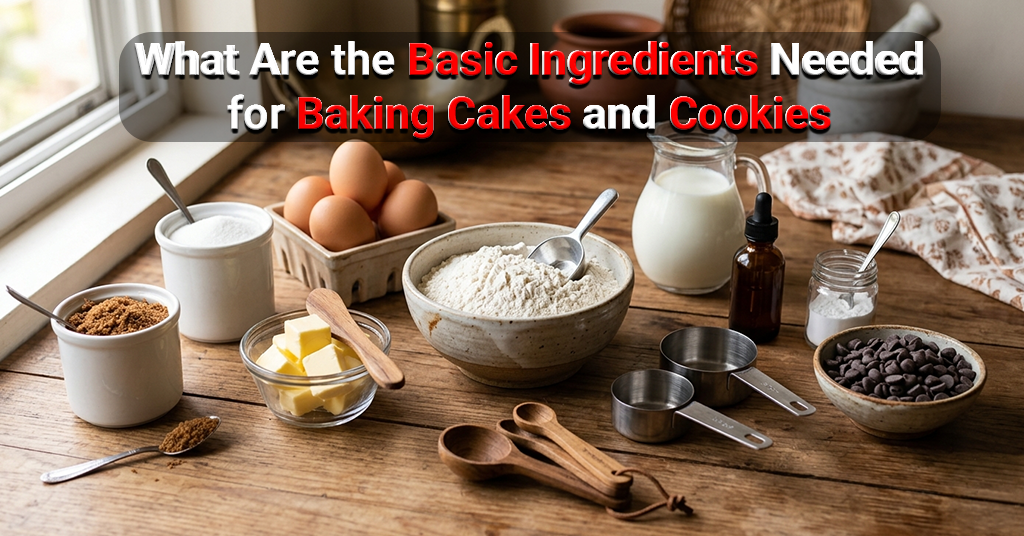
Let us begin at the very foundation. Every cake, every cookie, every crumb you have ever loved started with a short list of essentials. These are not exotic. They are humble, everyday things and that is exactly what makes them powerful.
Flour gives structure. It is the skeleton of your bake. All-purpose flour works well for most cakes and cookies, and learning to measure it correctly spooned into the cup, not scooped is the first real lesson.
Sugar does more than sweeten. It retains moisture, softens texture, and helps your bakes turn that perfect golden shade. Brown sugar brings depth and chew. White sugar keeps things light and crisp.
Butter brings flavour and richness. The temperature of your butter matters more than most beginners expect. Softened butter creams differently than cold butter. Melted butter changes a cookie’s spread entirely.
Eggs bind, lift, and add moisture all at once. They are doing three jobs silently every time you add them.
Leavening agents baking powder and baking soda are what make things rise. They are not interchangeable. Each has its own chemistry, and knowing the difference builds confidence quickly.
Salt. Just a pinch. It sharpens every other flavour in the bowl. These six form the core. Everything else evolves from here.
Essential Baking Ingredients List for Cakes and Cookies
Once you are comfortable with the basics, you will find that most bakes ask for a few more supporting ingredients. Milk or buttermilk adds tenderness and helps with browning. Vanilla extract deepens flavour in a way that is hard to define but easy to taste. Cornstarch thickens fillings and softens cookie texture when added to the dough.
Oil, in some cake recipes, replaces butter entirely and the result is a cake that stays moist for days. Cream cheese, heavy cream, and condensed milk each open up entirely different textures and flavour profiles once you are ready to explore beyond the basics.
Each ingredient on this list is a quiet decision the baker makes. And every decision builds your language as a baker.
Must-Have Ingredients for Baking Cakes and Cookies
If someone asked us what to always keep stocked in a baking kitchen, we would say this: plain flour, caster sugar, unsalted butter, eggs, baking powder, baking soda, salt, and good vanilla. With these eight things, you can bake more than you think.
The trap most beginners fall into is over-complicating the pantry. They buy specialty items before they have mastered the essentials. Then, when the basics go wrong, they do not know why because they have not yet built that quiet, reliable relationship with each ingredient.
Mastery does not come from variety. It comes from repetition with the fundamentals.
Beginner Baking Ingredients for Cakes and Cookies at Home
Starting at home is a brave and beautiful thing. The kitchen becomes your classroom, and every batch successful or not teaches you something. But there are a few things that genuinely make the beginning easier.
Use a kitchen scale. Volume measurements vary. Weight does not. This single change will improve your results immediately.
Keep your ingredients at room temperature unless the recipe says otherwise. Cold eggs dropped into creamed butter can cause the batter to split. Room-temperature ingredients cooperate.
Read the full recipe before you begin. Not while you bake. Before. This one habit will save you from most beginner mistakes. And when something does not turn out right, do not abandon the process. Investigate it. The failure is trying to tell you something.
Baking is not a skill that arrives fully formed. It grows slowly, the way understanding always does. It shapes itself through flour-dusted afternoons and batches that needed just a little more time in the oven. If you are standing at that beginning moment, looking at a bowl and wondering where to start know that the ingredients in front of you are already enough. They have always been enough.
And if you want to go deeper, our cake baking classes in Anna Nagar and our Diploma in Bakery and Patisserie Arts are built for exactly this moment for the baker who is ready to move from wondering to knowing.
The oven is warm. Begin.
