
You’ve followed the recipe. You’ve used the same oven, the same butter, the same brand of flour you always buy. And yet the cake came out dry. Or the cookies spread too thin. Or the bread just didn’t rise the way it should have.
Sound familiar?
Most home bakers who walk into our baking classes in Anna Nagar carry this exact frustration with them. They’re not careless people. They’re passionate, curious, genuinely devoted to getting it right. But somewhere between reading the recipe and reaching into the flour bag, something slips and the result speaks for itself in the worst way.
The culprit, more often than not, isn’t the recipe. It’s the measuring.
Why Is It Important to Make Accurate Measurements?
Baking is not like cooking. In cooking, instinct has room to breathe. A little more garlic, a splash of extra wine these choices add character. In baking, those same instincts can quietly dismantle everything.
Every ingredient in a baked good plays a precise role. Flour provides structure. Sugar adds sweetness but also moisture and browning. Butter creates tenderness. Eggs bind and lift. When these elements are in balance, something almost magical happens in the oven. When they’re off even slightly the chemistry shifts in ways your taste buds will definitely notice.
Accurate measurement is the language baking speaks. Learn to speak it fluently, and your results evolve from inconsistent to reliable.This isn’t about being rigid. It’s about understanding the foundation before you begin to build on it.
What Happens If Ingredients Are Not Measured Correctly?
Here’s the honest truth: small errors feel harmless in the moment and enormous on the plate.
Too much flour and your cake becomes dense, dry, crumbly the kind that needs a glass of water to get through. Too little, and it collapses into itself, gummy and structurally defeated. Extra baking powder creates a rise that falls just as dramatically. Not enough sugar and the browning suffers, taking flavour along with it. Every wrong measurement shapes the outcome in a different direction.
And the hardest part is that these mistakes rarely announce themselves while you’re mixing. The batter might look fine. The smell during baking might even be encouraging. It’s only when you slice into it, or take that first bite, that the truth surfaces.
Understanding what goes wrong and why is the first step toward not repeating it.
What Is the Importance of Using Proper Tools in Measuring Ingredients?
A teaspoon is not always a teaspoon. That sounds strange, but it’s true.
A heaping teaspoon of baking soda versus a levelled one can be the difference between a perfectly risen loaf and one that tastes faintly of metal and regret. A coffee mug used as a “cup” measure holds a different volume than a standardised measuring cup. These aren’t dramatic differences on paper but baking amplifies them.
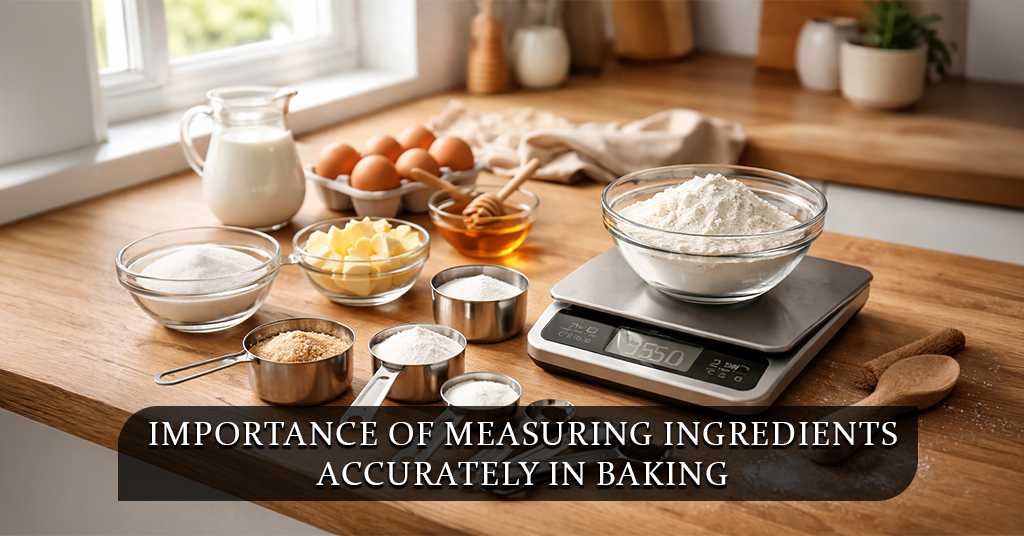
Proper tools dry measuring cups, liquid measuring jugs, a reliable digital scale, measuring spoons aren’t accessories. They’re instruments. The way a scale is to a jeweller, or a thermometer is to a doctor.
Investing in the right tools builds confidence. More importantly, it builds consistency.
What Are the Three Importance of Measuring Tools?
If there are three things the right measuring tools give you, they are accuracy, repeatability, and trust.
Accuracy means your ingredients reflect what the recipe actually calls for not an approximation, not a guess.
Repeatability means that when something works beautifully, you can recreate it. Again and again. Because you know exactly what you did.
Trust means you stop second-guessing yourself mid-bake. You follow through with certainty, because the foundation was set correctly from the start.
These three things together are what separates a baker who occasionally gets lucky from a baker who consistently gets it right.
How to Measure Ingredients Correctly and Accurately?
For dry ingredients like flour, the method matters as much as the tool. Spoon the flour gently into the measuring cup, then level it off with the flat edge of a knife. Never scoop directly from the bag that packs the flour in and adds far more than intended. Better still, use a digital scale. Grams don’t lie.
For liquids, always use a transparent measuring jug and check at eye level. What looks like a cup from above can be significantly less when viewed straight on.
For smaller quantities baking powder, salt, spices use proper measuring spoons and level them off. Even a small excess of baking soda can leave a bitter, soapy note in an otherwise perfect bake.
These aren’t complicated habits. They just need to become your habits.
The Baker You’re Becoming
Here’s what we’ve observed, teaching baking to hundreds of students over the years: accuracy doesn’t limit creativity. It unlocks it. Once you understand the rules and trust your measurements, you begin to see exactly where there’s room to experiment and where there isn’t.
That’s the philosophy behind everything we do at the baking class in Chennai. We build bakers who understand why, not just how.
If you’re ready to go deeper to bake with precision, confidence, and real craft our Diploma in Bakery and Patisserie Arts offers exactly that kind of grounded, professional training.
And if you’re looking to explore baking courses in Chennai that meet you where you are and take you somewhere better, we’d love to be part of that journey.
You started by wondering what went wrong. You’ll finish by knowing exactly what went right.
That’s the shift. That’s the whole point.
