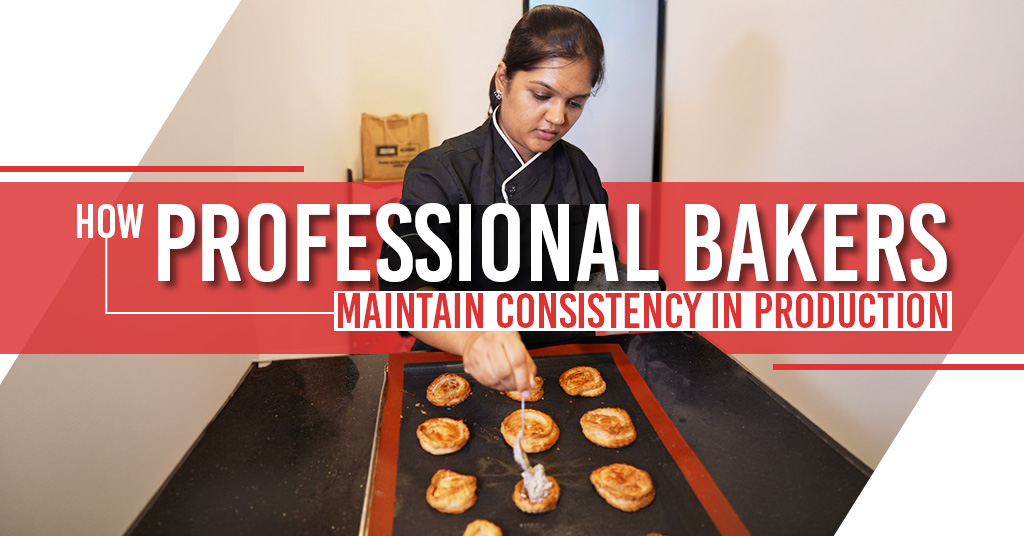
There is a moment every serious baker knows. You pull a tray from the oven, and something feels slightly off. The colour is a shade too deep. The crumb is a little tighter than yesterday’s. The texture that earned you compliments last week seems to have quietly changed overnight. Nothing catastrophic. But you notice. And that noticing that quiet anxiety is where the real education begins.
Consistency is not a skill you learn once. It is something you build, slowly, through repetition and honest observation. At our bakery training in Chennai, we meet students who arrive with passion and creativity already intact. What they are searching for is something more grounding the ability to produce the same beautiful result, again and again, regardless of the day, the season, or the mood in the kitchen.
That search is worth taking seriously.
What Is Consistency in Bakery?
Before we can chase it, we need to understand what consistency actually means in a professional bakery context. It is not rigidity. It is not the absence of creativity. Consistency means that your customer receives the same experience every single time the same flavour, the same texture, the same appearance, the same emotional satisfaction.
It is the invisible promise a baker makes. And breaking it, even once, costs more than most beginners realise.
Professional consistency evolves from two places: a deep understanding of process and an honest relationship with ingredients. When both of those things are in place, the result becomes predictable in the best possible way.
What Is a Key Factor in Ensuring Consistent Product Quality in a Bakery?
If there is one thing that separates a home baker from a production-level professional, it is standardisation. Not creativity. Not talent. Standardisation.
This means written recipes with exact gram measurements, not cups. It means recording oven temperatures and proofing times in a production log. It means tasting every batch against a benchmark and asking honestly whether it matches.
Temperature is particularly unforgiving. A five-degree variation in your oven can change everything colour, rise, moisture retention. Professional bakers do not guess. They document, they measure, they verify. The discipline feels tedious at first. Then one day it saves you entirely, and you understand why it matters.
Ingredient quality must also remain constant. Flour from different harvest seasons behaves differently. Butter fat content varies by brand. Understanding your materials, not just your method, shapes your ability to deliver reliability across hundreds of batches.
How to Be Consistent in Baking?
Consistency is built through habits, not talent.
The most consistent bakers we have trained share one quality: they do not rely on memory. They write everything down. They create systems that remove guesswork. They understand that consistency is not about being mechanical, it is about creating enough structure that creativity can flourish safely within it.
Mise en place is the foundation. Every ingredient weighed and ready before the process begins. This single practice eliminates the small errors that accumulate into big failures.
Proofing environments matter deeply. Dough responds to humidity and ambient temperature. Serious bakers monitor both, adjust both, and record what they observe. They build a personal database of knowledge that evolves over months and years.
And they rest. Fatigue is an underrated enemy of consistency. A tired baker rushes. A rushed baker cuts corners. The corners that get cut are always the ones that matter.
What Are the 7 Stages of Baking?
Understanding the stages of baking gives you control at every point in the process and control is what consistency is built upon.
The seven stages are: scaling, mixing, fermentation, shaping, proofing, baking, and cooling. Each one is a decision point. Each one either reinforces or undermines the work that came before it.
Scaling ensures your ratios are exact. Mixing develops gluten structure in a specific, intentional way. Fermentation builds flavour, and rushing it loses depth. Shaping determines texture and rise. Proofing is where patience lives. Baking transforms everything that came before it. And cooling often ignored allows the structure to fully set. Cutting into a loaf too early is not impatience. It is a mistake.
When bakers understand these stages as a connected sequence rather than isolated steps, something shifts. They stop working on bread. They start working with it.
The Mindset That Makes Consistency Possible
Technique can be taught in a classroom. Mindset takes longer.
The bakers who achieve true consistency are the ones who stay curious about failure. They do not dismiss a bad batch. They sit with it. They trace it back through the seven stages and find where the decision went wrong. They are honest with themselves in a way that is genuinely difficult.
This mindset is something we nurture carefully in our 6 months international diploma in baking and patisserie a programme built for those who want to move from enthusiastic to exceptional.
Coming Back to That Moment
Remember that moment at the oven door? The slight wrongness that only you could feel?
That sensitivity is not a weakness. It is the beginning of mastery. The baker who notices is the baker who improves. And the baker who keeps improving, honestly and patiently, is the one who eventually earns something rare, the trust of every person who takes a bite of their work.
If you are ready to build that kind of foundation, our cake baking classes in Anna Nagar offer a place to begin. Not with pressure but with purpose.
Consistency is not about being perfect. It is about caring enough to keep trying to be.
