You walked into a bakery once maybe it was a Sunday morning, maybe you were picking up a birthday cake and something stopped you. The smell of warm butter and vanilla. The way those croissants were stacked just so. You stood there a little longer than necessary, and somewhere in the back of your mind, a quiet thought surfaced: I want to learn how to do this.
That thought doesn’t go away easily. It comes back when you watch someone frost a cake on Instagram. It comes back when your home-baked cookies turn out flat again. And eventually, it brings you here wondering whether to sign up for a weekend baking class or dive headfirst into a professional bakery course in Chennai.
We understand that moment well. At our baking class here in Chennai, we’ve seen hundreds of students arrive with that same look excited, a little uncertain, and not quite sure which path makes sense for where they are right now. So let us talk honestly about this, the way a mentor would, not a brochure.
The Real Difference Between Beginner and Professional Baking Courses
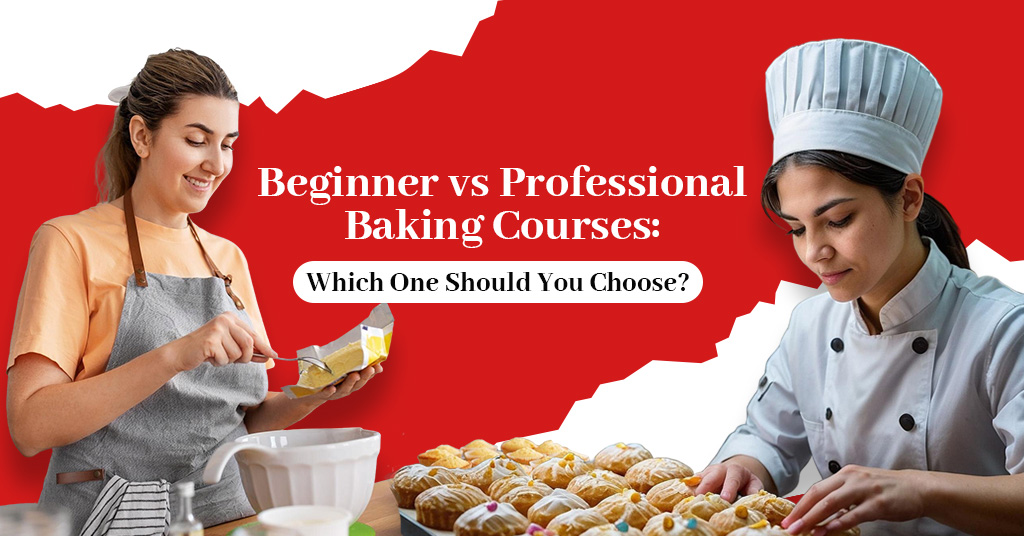
A beginner course teaches you what baking feels like. A professional course teaches you why baking works.
That distinction matters more than most people realize. In a beginner class, you learn to follow a recipe successfully to get a sponge cake to rise, to make a ganache that sets properly, to shape bread without it falling apart. It’s practical, approachable, and genuinely satisfying.
A professional course, on the other hand, builds the science underneath all of that. You begin to understand how gluten develops, why fermentation changes a dough’s character, how temperature affects emulsification. The recipe becomes a starting point, not a script. That shift in understanding is what separates someone who bakes from someone who can bake anything.
Beginner vs Professional Baking Courses: Which Is Actually Better?
Neither is better. But one might be better for you, right now.
If you’re baking for the first time or coming back after years away from the kitchen, a beginner course gives you something precious confidence. It removes the fear of failing. It lets you make mistakes in a space where mistakes are part of the process, not something to be embarrassed about.
If you’re someone who already knows your way around a mixing bowl, who has spent time baking at home and finds yourself wanting more than a recipe can offer then a professional course won’t just teach you. It will reshape how you think about food entirely.
How to Choose the Right Baking Course for Beginners
Start by asking yourself one honest question: what do I actually want out of this?
If the answer is “I want to bake better at home” or “I want to make pastries for family gatherings,” a beginner or intermediate course is a meaningful, well-suited choice. You’ll walk away with skills you’ll use immediately, and you’ll enjoy every session without feeling overwhelmed.
If the answer involves words like “career,” “my own bakery,” “selling,” or “I want this to be my life’s work,” then you need more than a weekend class. You need structured, progressive training that builds one layer upon another.
Be honest with yourself here. There’s no wrong answer, only an honest one.
Professional Baking Course vs Basic Baking Course: What the Journey Looks Like
A basic baking course typically runs a few hours to a few weeks. You cover the essentials cakes, cookies, basic breads, simple pastries. It’s warm, welcoming, and designed to be accessible.
A professional course is a longer commitment. Programs like the Diploma in Bakery and Patisserie Arts at Zeroin Academy are structured to take a student from foundational techniques all the way through advanced patisserie, bread artistry, and the business side of running a baking operation. It’s the kind of course that doesn’t just fill your portfolio, it shapes your identity as a baker.
The timeline is longer. The investment is greater. So is the transformation.
Which Baking Course Is Best for Beginners?
The best beginner course is one that doesn’t make you feel like a beginner for long.
Look for courses that explain the why alongside the how. Look for small batch sizes where an instructor can actually watch your hands and correct your technique. Look for a space where questions are welcomed, not rushed past. A good beginner course plants a seed of genuine understanding, so that when you’re ready to go deeper, the ground is already prepared.
One Last Thing Before You Decide
We started this conversation with that quiet moment in the bakery. That feeling of wanting something more.
Here’s what we’ve learned from years of teaching in this city: the students who thrive aren’t always the ones with the most natural talent. They’re the ones who chose the right starting point and then kept going.
Whether you begin with a short course to find your footing, or you’re ready to commit to something more serious, what matters most is that you begin.
Our baking classes Anna Nagar are designed with exactly that in mind to meet you where you are, and help you become who you’re trying to be in the kitchen.
The oven is warm. The door is open.
